NativeX: A Startup’s Lasting Economic Impact to a Region
The NativeX story is a real-world example of rural tech momentum. It illustrates how a single company headquartered in the small town of Sartell, just outside of St. Cloud, helped develop a durable “operator base” across Greater Minnesota.
Successful startups don’t just create exits and wealth – they create ecosystems. The impact of a single successful company can extend across decades and touch hundreds, even thousands, of lives. That has certainly been the case here in Minnesota. The NativeX story is a real-world example of rural tech momentum. It illustrates how a single company headquartered in the small town of Sartell, just outside of St. Cloud, helped develop a durable “operator base” across Greater Minnesota. More on that later.
First, some background about Minnesota as a business state, and how the out-state region (“Greater Minnesota”) has played into that. Minnesota’s original giant industries, mining and forestry (which together created immense wealth in the northeastern part of our state), gave way gradually over the past century to other business sectors. Certainly, the grain milling business also became a significant industry in the state.
What is arguably the major industry focus today, of course, is technology. It has decidedly been a slow but steady transition. The state’s computer industry took hold in the ‘40s and ‘50s. Food and ag even earlier than that. Software and medtech began blossoming in the ‘60s and ‘70s. By the early 2000s, technology was everywhere, permeating each and every one of the state’s industry sectors. Software wasn’t just eating the world, as Marc Andreessen so famously said – it ate a good portion of Minnesota in that process, too! There have been several successful software-focused startup exits (or IPOs) in Minnesota in ecommerce, supply chain, data storage, 3D printing, SaaS platforms, fintech, and more over recent decades.
Much of this business progress became centered in Minnesota’s major metro area, for various reasons. But increasingly that urban concentration has become less and less of a requirement. It’s a big state! And officials, entrepreneurs, and investors have come to know that innovation, startup formation, and workforce development can take place well beyond the big cities.
The Giants Founded Out-State
For more historical context, think about all the hugely successful companies that were started in Greater Minnesota. 3M actually began in the Duluth area. Taylor Corp was founded in Mankato. Fastenal started and remains in Winona, as does Hormel Foods in Austin. To the northwest, DigiKey was founded in Thief River Falls, retailer Scheels began in Moorhead, and is now just across the river in Fargo – as is the former Great Plains Software, which was acquired by Microsoft for $1.1 billion in 2001. The total valuation of these firms today is approximately $166 billion! [3M $86B, Taylor est $2.4B, Fastenal $47B, Hormel $13B, DigiKey est $6B, Scheels est $1B, Great Plains now part of a Microsoft unit likely valued at $10B or more today.] Yes, all these firms and others were founded out-state, not in a major metro. And many people today believe conditions are even more favorable for rural and smaller town firms to sprout and thrive.
One Startup That Made a Difference
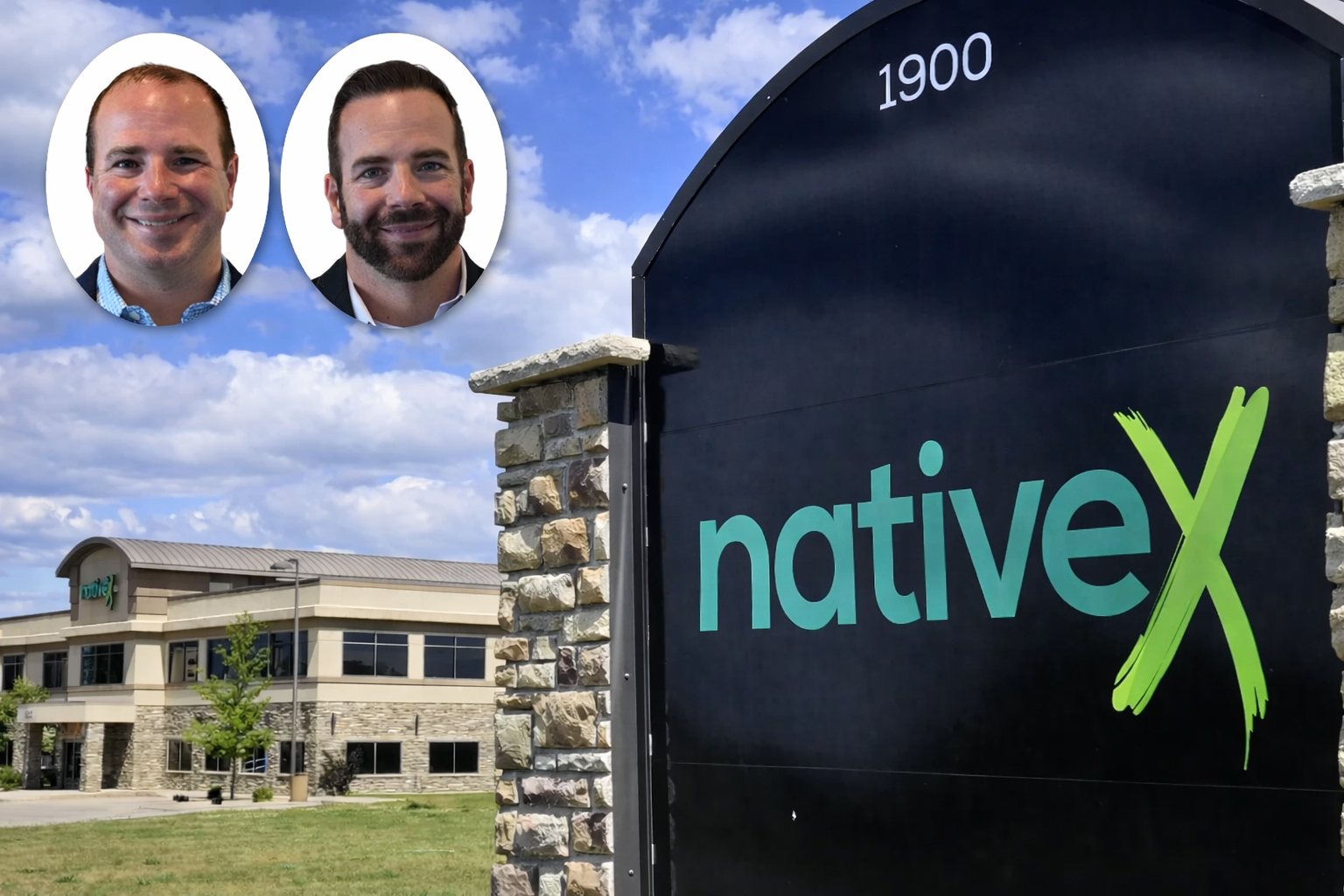
The concrete example mentioned above, NativeX, was a technology firm that had its beginnings in the St. Cloud area 20+ years ago. Three brothers, Rob, Ryan, and Aaron Weber. Rob and Ryan (pictured), who had both graduated from St. Cloud State University, founded NativeX in the early 2000s. (It was originally named W3i.) It became a leader in the world of mobile advertising technology, which is detailed in this previous article.
Here are the highlights of the NativeX success story:
It Achieved a Significant Exit: The company returned more than $40 million to shareholders when it was acquired in 2016, creating wealth in Greater Minnesota.
It’s Had an Ongoing Impact: More than 150 of its alumni are still working in the region today, generating sustained economic activity.
Continuing Salary Contribution: Annual wages from alumni employment in the region are estimated to be $10 million.
It Created at Least 10 New Founders: Several alumni launched their own companies, creating next-generation opportunities.
Ecosystem Leadership Impact: Many alumni now serve as senior operators, mentors, and angel investors.
“As a quick exercise, we found 200 of our alumni on LinkedIn, and learned about 70 of those are still in Greater Minnesota,” said Ryan Weber. “NativeX had satellite offices in the Twin Cities and San Francisco, and had some staff commute to St. Cloud at different times, so only about 40% to 50% of its alumni were ever based in Greater Minnesota. Thus, for 35% to remain in Greater Minnesota years after exiting is a substantial percentage of those that ever resided there.”
This recent review of former NativeX team members (out of a total of 500+ employees) revealed that more than 95% of those they reviewed remain employed in technology or related fields. “The ones who still live and work in Greater Minnesota contribute directly to the region’s economic vitality,” Ryan said.
The review Ryan did found that NativeX alumni now hold leadership, technical, and entrepreneurial roles across such industries as healthcare, finance, manufacturing, software, and digital marketing. Some 40% are in technical and engineering roles, 35% are business and marketing professionals, and 15% are entrepreneurs or consultants. Key employers of these alumni include Preferred Credit Inc. (PCI), Microbiologics, Wolters Kluwer, Best Buy, Jamf, Target, SPS Commerce, DigiKey, and Optum. About 10% of NativeX alumni have advanced to C-suite and director-level positions such as CTO, COO, Director of Engineering, Director of Marketing, and Chief Human Resources Officer. At least six currently hold executive roles at Greater Minnesota companies.
“Since its founding, NativeX has played a pivotal role in advancing the digital economy of Greater Minnesota,” said cofounder Rob Weber. “Our company didn’t just create jobs – it cultivated a generation of technical and entrepreneurial leaders who continue to drive innovation across the region.”
The ongoing economic impact of the company cannot be denied, with the majority of Greater Minnesota alumni continuing to generate high-value employment in Greater Minnesota, many in roles paying well above the regional median wage. And those alumni who chose their own entrepreneurial pursuits further amplify this impact through new business formation, local hiring, and professional service spending.
Where the NativeX Success Led Its Founders
About a year after the successful acquisition of NativeX, the Weber Twins, (Rob and Ryan) made a decision about what they wanted to do next. They decided to launch a venture capital fund. Having already done many successful angel investments over the years, they saw it as a natural progression. Beyond that, they strongly believed they could deliver more value to founders by leveraging their operational knowledge and network with those founders. They had observed that most Midwest VC partners had never scaled a business before and knew that founders invariably preferred VCs who were former operators. Their VC firm, Great North Ventures, soon closed a first fund of $24 million. You can read more about their transition from operators to operator-focused VCs here.
What Are the Implications?
What does the NativeX success story mean for founders? It helps illustrate that you can build a startup anywhere these days, including in Greater Minnesota. And if you can build a strong culture and a loyal workforce, you may just be able to create a lasting impact for many years in your community or region.
What does it mean for anyone who aspires to join a startup? Whether that startup is in a metro area or out-state, realize you not only have the opportunity to learn a lot and contribute to a growing venture, but you may be laying the groundwork to be part of an ongoing ecosystem with your fellow coworkers that will further enhance your career.
What does it mean for policymakers? Don’t count out Greater Minnesota as a source of economic vitality and innovation in our state’s multi-faceted and now technology-driven economy.
“The NativeX alumni network is one of the most enduring legacies of the Central Minnesota tech ecosystem,” said cofounder Rob Weber. “What began as our small startup in Sartell evolved into a training ground for future leaders who now shape the regional digital economy – from PCI’s engineering department to independent consultancies and growth-stage tech companies across St. Cloud, Sauk Rapids, and beyond.”
“At NativeX, we didn’t just grow a company. We also grew a generation of innovators who continue to define what’s possible in Greater Minnesota,” added Ryan Weber. “And we have big expectations for the continuing economic vitality of the area as technology advances even further in our world and in our state.”
Looking Ahead: The Next NativeX Is Already Out There
The NativeX story isn’t just history. The brothers say it’s the foundation of how Great North Ventures invests today. As its founding partners, they point out they have a firsthand understanding of:
What it takes to build a tech company outside of a major metro
The realities founders face in Greater Minnesota
How to recruit and develop local talent, and when to go elsewhere
What it means to scale across geographies, from Sartell to Minneapolis to San Francisco (as NativeX had offices in all three locations)
Why operator experience matters more than theory
“This is why Great North Ventures has a Minnesota-first investment philosophy with national reach,” said Rob Weber. “It’s not a marketing line – it’s lived experience.”
“Across our funds, we’ve invested $17 million into Minnesota-based companies – 40% of all dollars invested,” notes Ryan Weber. “That has included $4 million into Greater Minnesota companies, or 10% of all dollars invested.”
The brothers note that, just as NativeX anchored technical growth in Greater St. Cloud, Great North Ventures aims to back the next generation of founders across Brainerd, St. Cloud, Duluth, Rochester, Moorhead, and the Twin Cities – while helping them scale far beyond the region.
“We built companies here, we’re raising families here, and we’re investing here,” said Rob Weber. “Our conviction is simple: Minnesota doesn’t need to send its best talent to the coasts to build meaningful tech companies.”
As the NativeX story makes clear, one company can reshape an entire region’s economic trajectory. In Greater Minnesota – where talent often stays rooted, communities are tight-knit, and operators are deeply loyal – the flywheel effect is even stronger.
“Today, we see early signs of that same spark in companies like HLRBO in Brainerd, Backhouse Brands in St. Cloud, and other tech startups emerging from small towns and regional hubs,” said Ryan Weber. “Many of these founders share the same profile NativeX did in the early years – high potential, strong technical instincts, and a desire to build from home.”
What’s clear is that Great North Ventures exists to support those founders, and to collaborate with co-investors, communities, and partners who share a vision for Minnesota-grown innovation. Because if there’s one takeaway from 25 years of NativeX alumni data, it’s this: When you build world-class companies in Greater Minnesota, the talent stays, the economy grows, and the region becomes a place where the next generation of founders can thrive.
“And when that happens,” says Ryan, “everyone wins – founders, workers, communities, and Minnesota’s entire innovation economy.”
Graeme Thickins is a startup advisor and an investor in Great North Ventures Fund I. He is also an angel investor in two subsequent Great North portfolio companies. He has written previously for and about Great North Ventures and its founders over several years.